Feeling nervous about doing a Q&A session in a foreign language is normal. Worries about speaking well, listening correctly, and showing a level of expertise all play into a situation where we don’t have control over what questions listeners will ask.
But there two ways we can significantly increase our control over the Q&A situation: preparation and Q&A language responses.
The first step in preparation is to Identify your Listeners where you determine who your listeners will probably be.
This not only allows you to prepare your presentation tailor-made for your particular audience, but in terms of Q&A, it also provides a kind of strike zone where you can guess what kinds of questions listeners might ask.
For example, sales people may ask questions about what characteristics of your product are superior to competitors’ products, whereas researchers may ask about testing methods and criteria. From there you can narrow down with higher probability what questions will be asked.
Identifying your Listeners also plays a role when choosing supporting material such as graphs and diagrams suitable for that particular audience. While choosing, look at your material from an “outside” point of view to spot questions listeners might ask.
So, Identifying your Listeners can give you a much clearer idea of what questions they will probably ask. Then you can start thinking about how to answer such questions while you are finishing preparing your presentation.
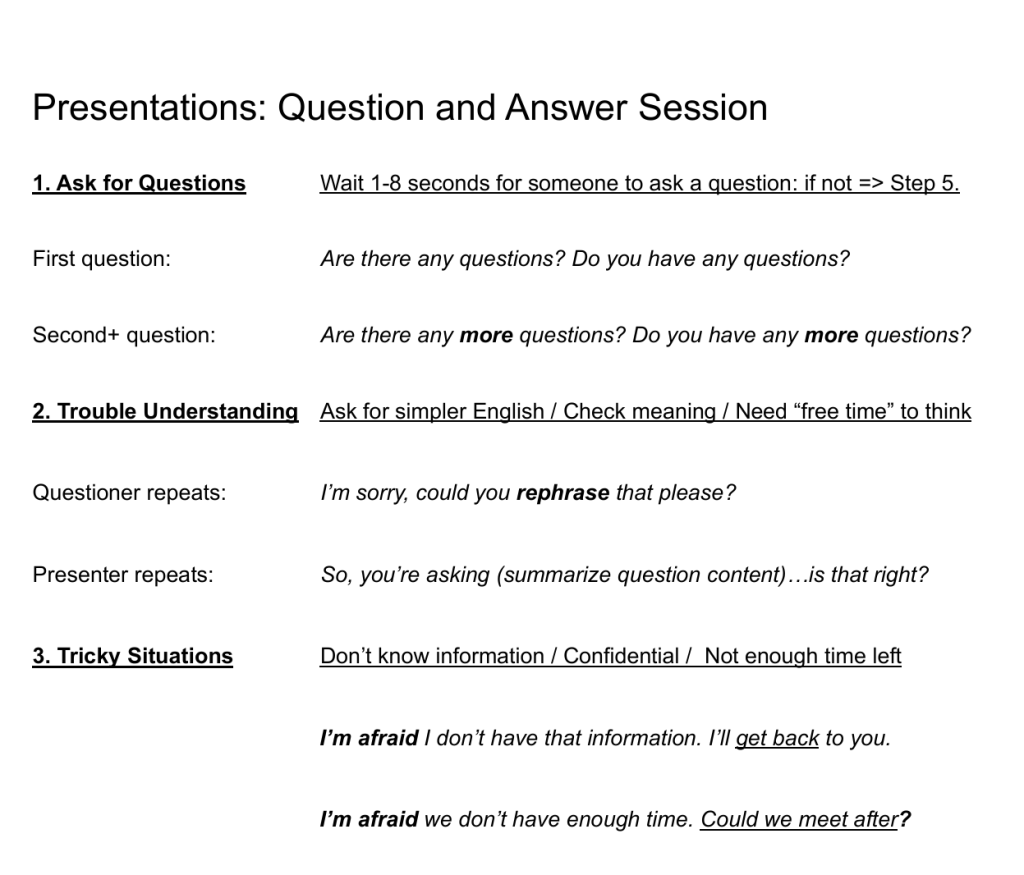
The second strategy to increase control is to use standard Q&A responses to questions. Control means two things: first you control the direction of the conversation with the question; second, by speaking politely (I’m sorry, I’m afraid…), you control the questioner, obliging them to follow the rules of polite behavior.
a. “Trouble Understanding” responses are for when you don’t understand the speaker’s English or you are not sure about the speaker’s meaning.
I’m sorry, could you rephrase that please? is a polite question that asks the questioner to repeat his question in simpler English. An added benefit of this response is that while the questioner is repeating the question, you have “free time” to think about how to answer.
So, you’re asking (summarize question content)…is that right? is used to check the questioner’s meaning. Usually, you are able to think of your answer at the same time as you summarize.
b. “Tricky Situations” responses are for when you don’t know the information, the information is confidential or the question is too broad to answer in the time left.
I’m afraid I don’t have that information. I’ll get back to you is a response allowing you to not answer, promising to follow up the question later by email or telephone.
I’m afraid we don’t have enough time. Could we meet after? is a response to avoid answering a question that may be difficult to explain, confidential or simply too detailed for the other listeners.
So, in summary, this two-way strategy of identifying your listeners to narrow down the range of questions, and using Q&A responses to control the direction of the discussion ensures a lower level of stress and a higher level of success for your next presentation.
Below is a one-page collection of Q&A responses: please feel free to download it!
 Advanced Business English Japan