Twenty years ago when I began teaching English in Japan, many companies needed just a few English speakers to take care of their business dealings overseas. These people were super students: naturally talented in learning languages and motivated by career opportunities to develop their English. (Japanese translation below)
Since then however, companies have slowly come to expect that almost every employee should be able to work in English to some degree. The problem is that some employees are unfortunately, not talented or highly motivated. For these employees, English means stress: they fear having yet another unsatisfactory performance in a teleconference or a presentation, and reliving those feelings of humiliation and frustration once again.
Well, the bad news may be that they have to study English more, but the good news is that some of their stress regarding speaking English is due to a misunderstanding of what they think the standard of acceptable English ability is.
When I taught English for the Burnaby School Board in Vancouver, I was told that of Greater Vancouver’s public school students who are taught in English, over forty per cent spoke a different language at home when they were with their families.
This means that, over time, with so many non-native speakers in the general population of Vancouver, in combination with the huge changes made to English by the internet and globalization, the native speaker standard has largely disappeared and been replaced with Global English: a simpler vocabulary, shorter sentences, and more casual in nature. As a result, it is unrealistic for me to expect to hear perfect 990 TOEIC English when I go back to Vancouver, and in fact, I hear many “mistakes” by non-native speakers as well as native speakers.
My impression is that, for Vancouverites, the standard of acceptable English ability seems to be that “if you can do the things you need to do quickly and smoothly, English mistakes are no big deal”.
Time is more important than perfect English. As long as you don’t waste anyone’s time, mistakes are quickly forgotten. I believe this is true of Global Business English as well.
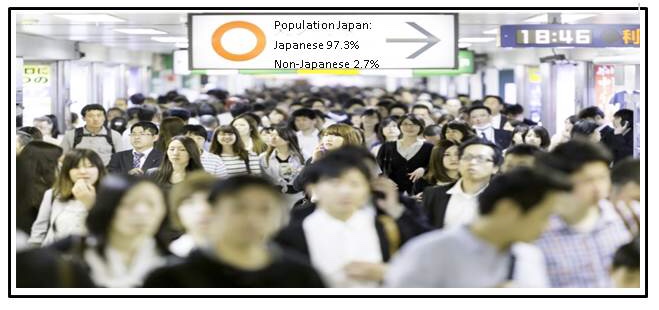
When we contrast Vancouver’s population with Osaka’s, non-Japanese non-native speakers make up just 2.7% of the population, meaning the remaining 97.3% are Japanese native speakers – the same as Japan as a whole (Stats-Japan 28/10/2019). With such a high percentage of native speakers, it is safe to say that Japan has a native speaker standard: there is a general expectation for Japanese and non-Japanese to speak properly and respectfully, especially in Business Japanese.
This is the source of the misunderstanding: due to the high Japanese native speaker standard, I believe that students think that they have to speak English as well as they speak Japanese, when actually the English standards of acceptable ability are much lower, as shown in yellow on the slide.
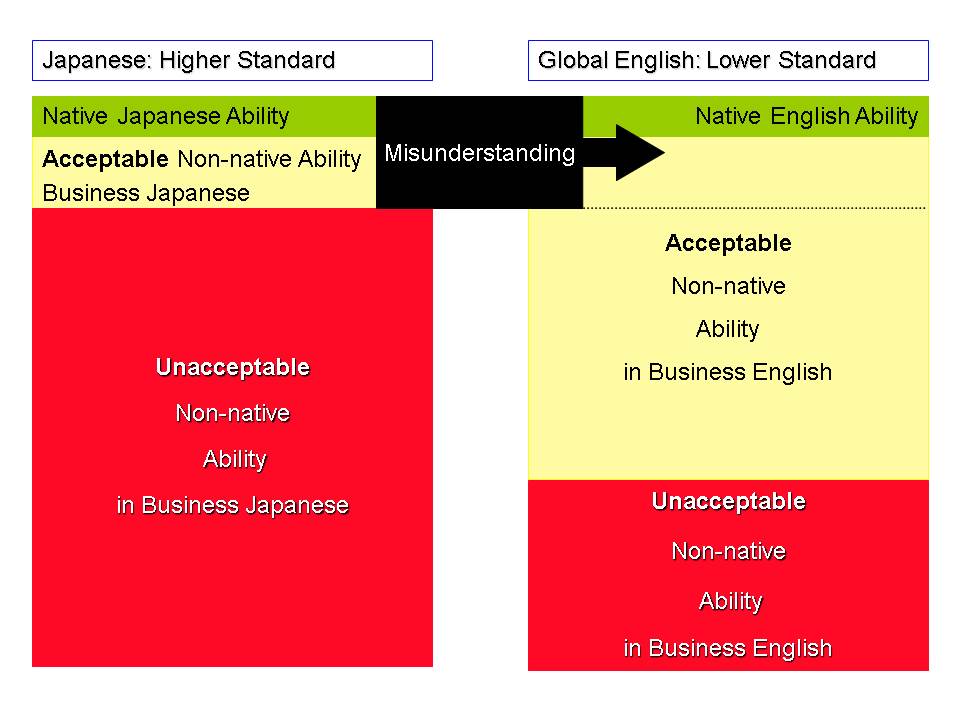 It’s not true: like Vancouverites, they only have to be able to speak well enough to do the things they need to do.
How much is enough? It really depends on what they have to do. The basic level is that they need enough vocabulary for the topic area in question; they should be able to make simple sentences with past, present or future meanings; they should be able to understand the other speakers enough and to respond quickly in some way–and if they can’t understand, then they have to be able to ask questions to check what the speakers say.
It is understandable that students are concerned about grammatical accuracy: they want to be able to explain what they think and they want their listeners to be able to understand what they say. For this, they need enough grammatical accuracy, but at a certain point of ability however, their listeners will understand their English even if they make a mistake with “a” or “the”, wrong vocabulary or a wrong tense. If their listeners can’t understand, they will ask questions to check the information.
My students who have returned from working overseas have realized this on the job: Business English is for doing business. It’s a practical point of view based on the reality of working with other English speakers, who are usually non-native. They often have to do something on a deadline, so they have learned to speak without hesitation: if they make a few mistakes here and there, it is not a serious problem. The point is to get the job done on time. And what’s amazing is their attitude to English: on the job they have seen the reality of what Global English means and as a result, they have become super students. They have seen a bright future overseas, and they want to develop their global work skills in presentations, meetings and negotiations. Business English is just a part of that development.
So when your Business English teacher says, “Don’t worry about mistakes so much”, they are actually trying to say, “Don’t apply a Japanese native speaker standard to English: responding quickly is more important than perfect English.”
二十年前、私が日本で英語を教え初めた時多くの企業はそこまで英語が堪能な人を必要とせず、少数精鋭で海外と取引をしていました。この精鋭はハイレベルな英語をすでに獲得した方達で、言語を学ぶのを努力し英語を上達させることでキャリアを着実に積む機会を多く得ました。
その後、企業たちは多くの社員に英語がある程度できることを前提と考えました。ここで問題なのは彼らの中には英語が苦手な方達や、学ぶのに積極的でない人たちがいるということです。彼らにとっては英語はただのストレスであり、テレビ会議やミーティングで恥をかく事を恐れているのです。
そして、彼らにとって英語を更に勉強しないといけないことは嫌な知らせかもしれないですが、良い知らせは彼らの考えている基準と求められている基準は違うということです。
私がバンクーバーのバーナービー校で英語を教えていた時、バンクーバー近郊で40%近くの公立高校の学生は英語で授業を受けるが家で他言語を話すということでした.(カナダの公用語の英語・仏語以外に20%の国民は家で違う言語を使うそうです。)
これが意味するのは英語を第二言語とする人たちはバンクーバーでもとても多く、インターネットと国際化も相まってネイティブの求める基準は大きく変わったということです。グローバルな言語となった英語はシンプルなボキャブラリーと短く簡潔な文で自然に喋ることが更に求められるようになりました。実際に私がTOEIC満点の990点を求めることは非現実的であり、バンクーバーに戻るとネイティブもそうでない人たちも多くの文法で間違えることがあります。
バンクーバーに住んでいる人たちが求めている基準は”もし英語で仕事が早くまた円滑にできるならば、文法はそこまで気にしなくても良い”です。時間のほうが文法ミスよりも大切で相手の時間を無駄にしない限りミスなんてすぐ忘れてくれます。私はこれがグローバルでビジネスで通じる英語の現実だと思っています。
ここでバンクーバーと大阪のネイティブとそうでない人たちの比率をみてみましょう。大阪で母国語が、つまり日本語が話せない人の割合は約3%です。ということは残りの97%は日本語のネイティブということになります。この比率は日本全体でみてもそこまで変わりません。これらから考えられるのは未だに日本ではネイティブの基準が存在し、第一言語として他言語を話す方達にもその基準が適用されることです。特にビジネスの場面では顕著にそれが現れます。
この図は日本人の方達が起こしている誤解を説明しています。これらが示すのは日本人のネイティブの基準が非常に高いことです。そして生徒たちは英語でもこの高い基準で話せないといけないと錯覚しているのです。ですが世界で実際に求められている英語のレベルはそこまで高くなく、図では黄色で記されている部分です。
バンクーバーにいる人達はタスクが達成できるレベルであれば問題ないのです。
ではどれくらいが十分とされるのでしょうか。それは各々何をするかによりますが、基本的に必要なのは十分な語彙と時節(現在・過去・未来)を使って素早く応答し、また何を行っているのかを理解できなければ十分です。出来ていない場合は話し手にもっと丁寧に説明するように頼むことで対処できます。
文法に気をつける事も良い方法です。ネイティブの人達はあなたが本当は何が言いたいのかを理解したいはずですからね。そして、それに対してどう思うのかを意見したいはずです。この対話を実現するためには最低限の文法が必要です。ですが、ある程度の英語が話せるようになると小さいミスはあっても気にせず理解を示してくれることが多いです。例えば冠詞のaとtheの使い方です。
海外から帰ってきた私の生徒たちは仕事をする上で一つ大切な事に気が付きました。それは、ビジネス英語はビジネスのための物であるということです。ビジネス英語の実践的な考え方は他の国の方たちとの仕事をどう成功させるかという現実を教えてくれます。一般的に彼らには締め切り日があります。何より大切なのはそれまでに仕事を終わらせることで小さいミスを恐れないようになったのです。小さなミスを起こして立ち止まるよりも、その仕事を締め切りまでに終える事の方が大切なのです。彼らの英語を学ぶ姿勢は精鋭達と遜色ありません。彼らは先の明るい海外に目をむけて、プレゼンテーション、ミーティング、交渉術などのグローバルに活かせるスキルを向上させました。ビジネス英語はその発展のきっかけに過ぎません。
ですから、もしあなたの先生がミスを恐れるなと言うのであれば、実際はこう言いたいのです。「日本人の基準を英語に持ち込まず、早く応答するほうが大切なのだ」と言うことを。
 Advanced Business English Japan