When you can see that listeners are not paying attention to your presentation, it feels terrible. Your chance to make an impression has vanished. So, how can you catch and hold listeners’ attention? Of course you need good material, an easy-to-follow structure and attractive slides, but that’s not enough either: what you really need is a good connection with listeners. (Japanese translation below)
This means that you have a kind of face-to-face conversation with your listeners in the way that you move around the presentation space, check your listeners’ understanding with eye contact, and tell your story with your face and hands. You create a feedback loop that lets your listeners participate by returning eye contact and facial expressions. This is how to hold full attention.
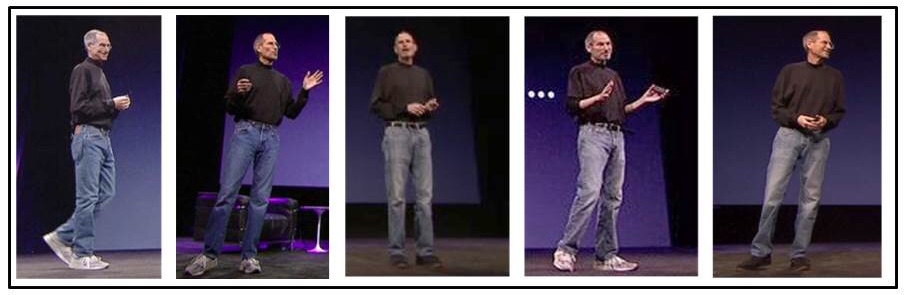
Move: Hold their Attention
Many of my presentation students stand in one place for their “Before” presentation. After the first few minutes, listeners start to pay less attention because it’s not active enough.
Why did Steve Jobs walk around? Why do TED Talks presenters move around? The reason is because human beings are like cats: our eyes are naturally attracted to movement. Moving around the presentation space in front catches our eyes and sustains our attention over the whole presentation.
You should be standing up straight and yet be moving around in a relaxed manner. “Straight” and “relaxed” may seem like two opposites but standing up “straight” communicates your polite appreciation for your listeners’ attention and yet, at the same time, by seeming “relaxed” in your movements, you also send the message that you are ready: you have prepared enough and you feel confident about your presentation. Even before you say your first words, straight yet relaxed makes your information more persuasive.
Make Eye Contact: Check their Understanding
In daily conversations we use eye contact to watch our listeners to see if they are listening, or whether they understand or disagree. This feedback helps us decide in real time whether they are interested in the topic, or whether we should talk about something else. Presentations have the same feedback loop: eye contact with listeners helps us decide in real time whether to speed up or slow down, or whether to add more background information. Good eye contact helps you achieve just the right pace for your particular audience.
Eye contact — perhaps the most basic form of communication — allows us to quickly assess whether another person is afraid of something, or is “telling the truth”. So, when presenters face the screen and make no eye contact, their listeners’ begin to think something is wrong: they usually think these presenters haven’t prepared enough. This conclusion means the basic agreement of the presentation situation is now broken: in return for well-prepared, well-explained information, listeners agree to sit quietly and pay attention. Presenters who are not prepared are wasting their listeners’ time – and listeners stop paying attention.
Animate your Face and Hands: Tell Your Story
Facial expressions are perhaps the most powerful link in making a connection with listeners. While your eyes are for receiving information from your listeners, your face is for sending information. Something as simple as a smile at the audience just before starting sets up a nice atmosphere. Most listeners will smile back — and look forward to what you will present.
Listeners expect your presentation to be a kind of story, with a beginning middle and end, and for you to be a kind of storyteller. If your story is the difficulty of your research and the satisfaction of achieving good results, then you should make facial expressions for “difficulty” and “satisfaction”: you should animate the story of your feelings at the same time as you tell your story in words and slides.
While faces animate feelings, hand gestures are good for animating numbers, shapes, actions or comparisons. Like movement, they catch listeners’ attention, but their most important value from an international presentation point of view is that everyone in the audience can understand them. For most if not all of your listeners, English is a foreign language and in every audience there is probably a mix of high and low levels of English listening ability. As an international presenter, you must help all of your listeners keep up. Simple gestures for “My second point is…” or “a huge increase” prevent low-level listeners from becoming lost, or help them note key points that they can follow up on later.
Rehearse: Coordinate your Body Language
In order to get movement, eye contact, facial expressions and hand gestures smooth and natural, presenters have to rehearse. The problem is that, for many Japanese presenters, a presentation in English requires so much preparation that they run out of preparation time and don’t have time to rehearse. But a basic fact about presenting is that, when we first stand in front of people we don’t know, the feelings we have are completely different than the feelings we have when sitting in front of our computers, silently practicing our presentations.
The step between silently practicing and actually presenting is role-playing: in an empty room, stand up and role-play your presentation at least five times using hand gestures, eye contact and speaking in a loud voice. Five times gets everything working smoothly: it helps relax your body and makes your movements and gestures and facial expressions balanced and natural. It reduces the stress you may feel about presenting, and that in turn increases your confidence. Confidence will allow you to use movement, eye contact, facial expressions and hand gestures at a pace suitable for your audience, ensuring a good connection and the full attention of your listeners.
あなたがプレゼンテーションをしている時に、聞き手があまり興味を示さないと精神的に辛いですよね。そうなってしまった時、このプレゼンでのあなたの成功は消えたようなものですから。ではどうすれば、聞き手の注意を惹くことが出来るのでしょうか。勿論良質な資料や印象に残るスライド達は重要です。しかしそれだけでは不十分なのです。プレゼンテーションにおいて最も大切なのは聞き手と良い関係性を持つことです。
それは、あなたが聞き手と向かい合い、会話をするように話す必要がある事を意味します。又、スペースを左右に行き来しアイコンタクトで聞き手がどれだけ理解できているのかを確認しましょう。そして聞き手に表情とジェスチャーを使って伝えましょう。この一連の動作を複数回行うことで聞き手の集中を切らさないようにしましょう。これらがプレゼンにおいて最も大切な聞き手と良い関係の作ります。
Move: Hold their Attention
私が担当した多くの生徒たちはプレゼンテーションをする際、所定の位置から全く動かず数分後には聞き手は集中を切らしてしまいました。なぜならプレゼンターのアクションが少なく地味だからです。
なぜスティーブ・ジョブズはプレゼンテーションの際にステージ歩き回るのでしょうか。なぜTEDトークの人たちもステージ上を歩き回るのでしょう。それは人間という生き物は、猫や他の動物達同様、動くものに目で追ってしまう習性があるからです。ステージ上を歩き回ることは聞き手の注意を引くために非常に効果的なのです。
立ち姿は堅実であるべきですがステージを歩く際はあなたが自身が自然体である必要があります。「堅実」と「自然体」は一見真逆の意味のようですが、堅実な雰囲気は、あなたの謙虚な印象を与え、また自然体な雰囲気はあなたに自信のある印象を聞き手に与えます。堅実な雰囲気と自然体な雰囲気はあなたが言葉を発する前から聞き手に影響を与えているのです。
Make Eye Contact: Check their Understanding
私達は普段から聞き手とのアイコンアクトで彼らが聞いているのか、その話題についての反応を伺ったりします。アイコンタクトで得た情報は話し手がその話題を続けるのか、はたまた違う話題を喋るのかの良い判断材料です。プレゼンテーションも例外ではありません。プレゼン中のアイコンタクトは話すスピードの強弱の調整、もしくは足りてない情報の補足説明など「察知」するために使えるという事です。
アイコンタクト ーアイコンタクトは基本的かつコミニュケーションツールの根幹です。アイコンタクトは瞬時にいろんな情報を私達に教えてくれます。例えば、話し相手が怯えているのか、真実を語っているのかなど多種多様です。プレゼンテーションに当てはめると、話し手が聞き手と一切アイコンタクトをせず詰まってしまった時、聞き手側の集中が途切れてしまい、用意不十分と思われてしまうのも無理ないですよね。この場合、アイコンタクトという根幹の要素が欠けているので、いくらハイクオリティーで用意周到な準備でも水の泡となってしまいます。さらに聞き手の集中が途切れてしまっているので「時間の無駄」とすら思われてしまうかもしれません。
Animate your Face and Hands: Tell Your Story
顔に現れる表情はもしかすると聞き手と一番強いコネクション産む可能性があります。アイコンタクトが情報の受け取りだとすれば、顔の表情は聞き手へ情報を送信するイメージです。プレゼンテーションを始める前に少し笑顔を見せるだけで場の雰囲気が柔らかくなるのを感じ取ることが出来ます。そして殆どの聞き手はこれから始まるものへの期待も込めて笑顔をあなたにかえすでしょう。
聞き手側はあなたのプレゼンテーションに起承転結のあるストーリー性を求めるでしょう。話し手というよりは語り手というようなイメージです。もしあなたのストーリーがあなたが研究をする中で体験した幾つもの苦難なのであれば、顔の表情は苦しい時のものとその後の達成感が感じられるような表情にしましょう。そしてそのストーリーを伝える上でスライドを駆使しそれぞれのスライドで表情をマッチさせましょう。
顔の表情はあなたが伝えたい気持ちを伝えるのを得意とするのに対し、ジェスチャー(身振り手振り)は数値、形状、対比を伝えるのに長けています。上記されているように、ステージを移動するだけでも聞き手の注意を惹くことは出来ます。しかし、あなた達のように国際的な場面でのプレゼンテーションで最も重要なのは、そのジェスチャーが誰でも理解できるということです。あなたの大多数の聞き手は英語を第二言語として使う人達でしょう。聞き手の英語のレベルに差異があることも考えられます。話し手として全ての聞き手に集中してもらうために、下のようなキーワードのときにわかりやすいジェスチャーを取り入れるといいでしょう。
ジェスチャーを取り入れることによって意味を強めたいところが更に強調され聞き手はより容易に意味を汲み取ることが出来るでしょう。
Rehearse: Coordinate your Body Language
話し手がステージ上でのスムーズな足運び、強いアイコンタクト、豊かな表現、ジェスチャーなどのこれらを使いこなすためにはリハーサルが欠かせません。多くの日本人のプレゼンターに見られる問題は英語でプレゼンテーションをする際、準備に時間がかかりすぎてしまい、練習をする時間が無いということです。プレゼンテーションの根幹は変わることはありません。ですが人前に出て話すのと静かに練習をする際では部屋に漂う空気は違います。
静かな部屋で練習をする際はロールプレイングを行うと良いでしょう。実際に席から立ち上がって5回程通しで練習をします。練習の中で、実際に聞き手がいることを想定してアイコンタクト、ジェスチャー、ステージでの足運び、また表情を作るようにしましょう。5回程通しで練習することによって色々な要素がスムーズに運ぶ用になるでしょう。このスムーズさを体験すると体と顔の表情はより自然体になりあなたに自信を与えるでしょう。この自信が本番のプレゼンテーションでいろいろな練習した要素を臆することなく発揮させるでしょう。それは、聞き手との強いアイコンタクト、ジェスチャーの使い方、ステージでの足運び、豊かな顔の表情での表現です。
 Advanced Business English Japan