
When preparing for presentations, many Japanese presenters worry that they might forget how to explain their slides in English. They generally use four techniques to help them remember: most read from notes in their hands or from sentences on their slides, a few memorize their whole presentations, and one or two use their slides as hints, looking at their slides and then ad lib their English as they speak.
While these techniques allow them to “survive” their presentations, the end results are less than satisfactory: there is almost no eye contact with listeners, the energy level is low due to reading or reciting, and the pace is slow, or in the case of slides as hints, stop-start-stop-start.
These techniques produce a very low impact: listeners stop paying attention because they expect a “live” experience, not a “recording” of a document. If listeners only wanted information from slides, they could simply read it. They want the presenter to explain the information and comment on it in order to help them understand the key points more quickly and deeply than if they just read the slides.
Let’s take a close look at the presentation situation. To get listeners’ attention a presentation needs to be “live”, the pace smooth and active, and the presenter needs to make a connection with the listeners, using eye contact and facial expressions.
On the other hand the presenter needs to be “in control” of all the skills needed to make an attention-getting presentation: movement, eye contact, facial expressions, hand gestures, slide changes, laser pointer use, a smooth pace and English. These are the characteristics that lead to a high impact.
So, how do presenters make their presentations “live”, and at the same time, keep it “in control”?
Well, I ask my students, how do J-pop stars perform live shows? Don’t they have the same problem of “live” and “in control”? I ask them which musicians they like and then ask them to compare the impact of listening to a musician’s CD and seeing them “live”: every student says the “live” shows have a higher impact. So how do J-pop stars do it?
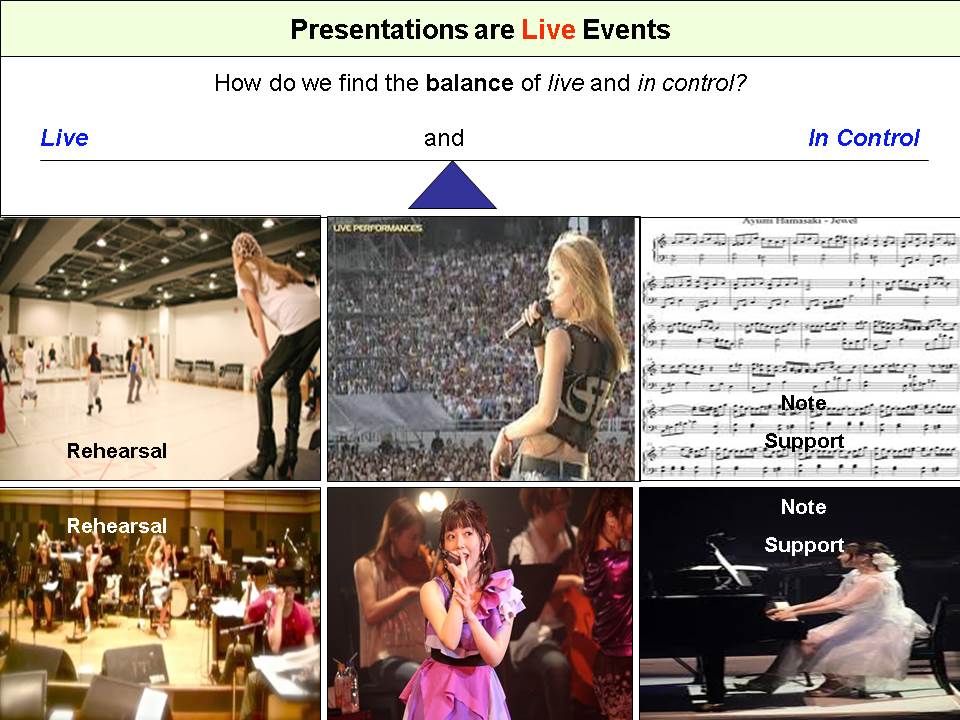
The answer lies in the balance between sheet music and rehearsals. They rehearse enough times for it to be in control but not so many times as to make it seem less “live”, and they have “notes” on stage to look at if they need to.
So the solution for Japanese presenters lies in the balance they have between notes and rehearsals. Presenters who read are usually all notes, no rehearsals. Memorizers are no notes but many, many rehearsals. Slides as hints presenters are no notes and perhaps a couple of rehearsals.

The balance I teach in my seminars is “Half and Half”: notes on the table and several rehearsals.
You go in an empty meeting room, role-play your presentation at least five times standing up, using hand gestures, making eye contact, changing slides, using the laser pointer and speaking in a loud voice. Five times gets everything working smoothly. It helps relax your body and reduces any stress you may feel about presenting and that in turn increases your confidence.
In contrast to slides as hints presenters, when you do forget how to say something however, you have notes on the table in front of you: there are no long silences trying to remember how to explain something. Key words are highlighted so you can locate them quickly. All sentences start on the margin so you don’t have to search for the beginning of a sentence. The font is large (eg. Arial 14) so your hands are free for gestures and the laser pointer.
Finally, you have much more confidence knowing that you have rehearsed enough and that you have notes as support on the table.
“Half and Half” makes it possible for you to make a great presentation.
Richard Eyre – May 2020
英語でプレゼンテーションをする際多くの日本人のプレゼンターは何を喋るかを忘れてしまいそうで不安になる傾向があります。一般的に彼らはいずれかの3つ対処法に当てはまります。1つ目は手元にあるノートをそのまま読む人、文を丸暗記する人、又はスライドにある文をヒントとしてアドリブで文をその場で作る人がいます。
これらの対処法はプレゼンテーションを切り抜ける手段としては有効的ですが、結果は十分とは言えません。なぜなら彼らのプレゼンテーションには足りない要素が幾つかあるためです。
それは
などが挙げられます。
上記されているようなテクニックは聞き手にあまり大きいインパクトを与えられません。その一つの理由として、聞き手は一発勝負のプレゼンを聞いているのに対しプレゼンター側は録画をしたビデオのように喋ることが挙げられます。聞き手とプレゼンターとで距離が生じているわけです。聞き手が特に求めているのは要点をまとめ更に深い内容にするための説明です。ただスライドを読み上げるだけならば聞き手側が読めばいいだけなので説明はいりませんよね。
もう少しプレゼンテーションに焦点を当てて考えてみましょう。聞き手の注意を惹くためにはそのプレゼンテーションが魅力的でなければなりません。魅力的で注意を惹くプレゼンにするための要素を例えると、英語がいきいきと喋りかつスムーズである事、聞き手とのアイコンタクトやプレゼンターの顔の表情で良い繋がりが出来ていることなどです。
しかし、この複数のテクニックをプレゼンの中で制御する能力も同時に求められます。例えばアイコンタクトだけが出来ていたり、ジェスチャーの表現だけが良かったりしても、聞き手の注意を長い間惹きつけるのは困難です。ですから、レーザーポイントを使ったり、喋るペース配分を考えたり、色々な要素のバランスと制御を行うことで、より大きなインパクトを聞き手に与えることが出来ます。
では、具体的にどうすればプレゼンターは魅力的でバランスの取れているプレゼンテーションを行うことが出来るのでしょうか?
私は生徒たちにこんな質問をしました。それは、「J-POPのアイドル、スターたちはどうして魅力的でバランスの取れているパフォーマンスができるのか答えてください」というものです。そしてこの質問からわかるのはプレゼンターも彼らと同じようにパフォーマンスしなければならないと言うことです。また生徒にあなたはCDかコンサートどちらを好みますか、というような質問をしました。そして答えは決まっていつもコンサートなのです。では彼らはどうやって高いクオリティを維持しつつ注意を惹くようなパフォーマンスが出来るのでしょうか。
彼らのパフォーマンスはリハーサルと台本の中間的な立ち位置でやっているため高い質が担保されているのです。リハーサルはコンサートの進行を制御するのを練習するのに非常に有効です。ですが、制御を幾ら練習したところで本番一発勝負ということに変わりありません。それを楽譜がサポートするのです。
アイドルを例としてあげると、彼らの魅力的なパフォーマンスはリハーサルと台本のバランスによって成り立っています。リハーサルをしない人は台本を読み上げるだけのパフォーマンスに。文章を全て覚える人は暗唱するだけのパフォーマンスになってしまいます。そしてリハーサルをし、文章もある程度覚えている人がプレゼンの画面をヒントに文章を考えてプレゼンテーションを行える人です。
私がセミナーで教えるのは、プレゼンにおける”Half and Half”、リハーサルと台本の長所を取り入れたプレゼンテーションの仕方です。
この“Half and half”を習得するための練習では、空いている会議室で5回ほど本番と同じようにリハーサルをします。このリハーサルで意識して行うのは次の五つです。
これら五つを重点的に練習することで自信に繋がります。
最後に、実践的なリハーサルと効果的な台本はプレゼンターの自信に繋がります。
“Half and Half” を習得することでより魅力的なプレゼンテーションを行うことができるでしょう。
 Advanced Business English Japan