Explaining is perhaps the most challenging skill to learn in any language.
But how many textbooks teach “explaining”?
I don’t know of one textbook: the reason I believe is that each explanation is so specific to each topic that it is very difficult to show one way to explain something.
So how can Japanese English students improve their explaining skills?
It seems to be something that they have to learn by experience, explaining as many different things as possible, over and over again.
One of the interesting topic areas I’ve found is “Japanese Culture Questions”.
I thought that when one lives overseas, as I do, one is often called upon to explain the behavior of other cultures.
My students will probably live and work overseas at some point, and they too will be ambassadors of Japanese culture.
Another important point is that the task is real: I really don’t understand!
Because it is Japanese culture, they are highly motivated to have me understand. It’s a lot of fun too.
1. What is the difference between “Nihon” and “Nippon” – why does Japan have two names for one country? When do I say one or the other – are there any rules or customs?
2. What is Radio Taiso and what is its purpose? Why is it so early in the morning? Is it done only during summer vacation?
3. During the New Years holiday, why do Japanese people eat cold food (ossechi) for two or three days in a row? Cold food doesn’t seem like food for a celebration… Do the different things in ossechi have particular meanings?
4. When giving a gift of money to the bride and groom at a Japanese wedding, how much money should be given? Is ¥20,000 suitable?
6. Many houses in Japan have long lines of clear plastic bottles full of water around them. Is this a religious thing or a kind of protection from something?7. When Japanese park their cars, they almost always back into parking spaces. To North Americans who drive straight in “headfirst”, seeing Japanese patiently wait for the driver in front of them to park is a bit of a surprise. Is there a reason why Japanese back in?
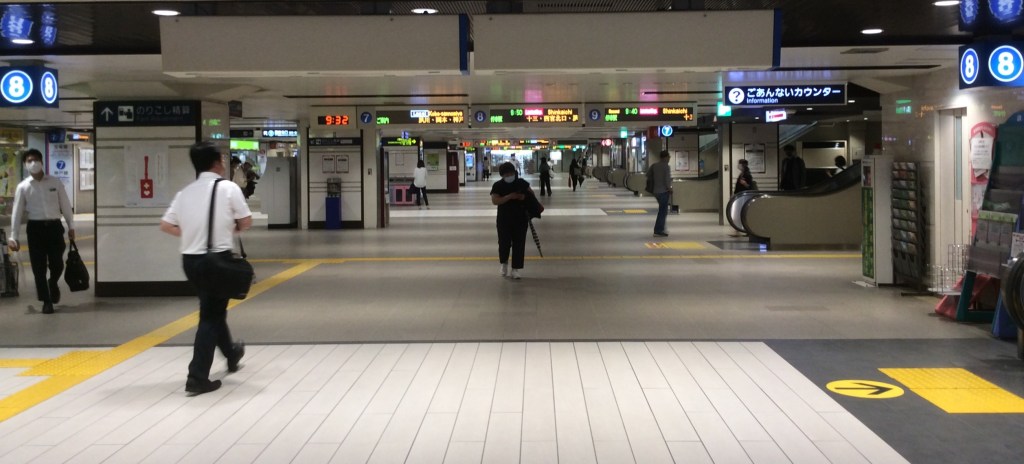
8. Why do people in Osaka and Kobe stand on the right side of escalators and not on the left side, as all other Japanese do in other parts of Japan?
9. Why do Japanese say the “go” traffic signal is blue –isn’t it actually green? Do they see blue?
10. Why do most Japanese housewives (not husbands) “control the wallet” and take care of the family finances?
11. Why do all Bon Odori dancers all dance in one direction? Who decides the direction? Why are there elderly ladies dancing on a stage in the middle?
12. What does a kadomatsu symbolize? What does a shimenawa on a door mean? In Japan, I see Xmas trees put up as early as October, so when is the right time to put out kadomatsu and shimenawa?
13. Why are there so few public garbage cans in the streets? How can Japanese streets be so clean and yet have so few garbage cans in the streets? What do people do with their garbage?
14. Packaged foods have so much wrapping: cookies for example are packaged in one big package and then each cookie is individually wrapped. Why are there so many layers of packaging?
15. Why are so many of the same people on so many different TV shows? Don’t Japanese TV viewers like a variety of people?
16. Why do Japanese houses have frosted glass in so many of the windows? Don’t they want to have a good view? Are views not important to Japanese people?
17. Why do some Japanese workers say “ohaiyogozaimasu” to each other even in the middle of the day? Did they just wake up?
18. In Japanese offices, why are there “islands” of desks and not separate desks? What is the purpose of this organization? Does it come from something else?
19. Why do Japanese sometimes do long coordinated claps of 3 claps each at meetings and social gatherings?
20. Why aren’t most streets named? Where did the system of intersection addresses and neighborhoods develop? Don’t Japanese get lost using this system?
 Posted with Blogsy
 Advanced Business English Japan
Leave a comment